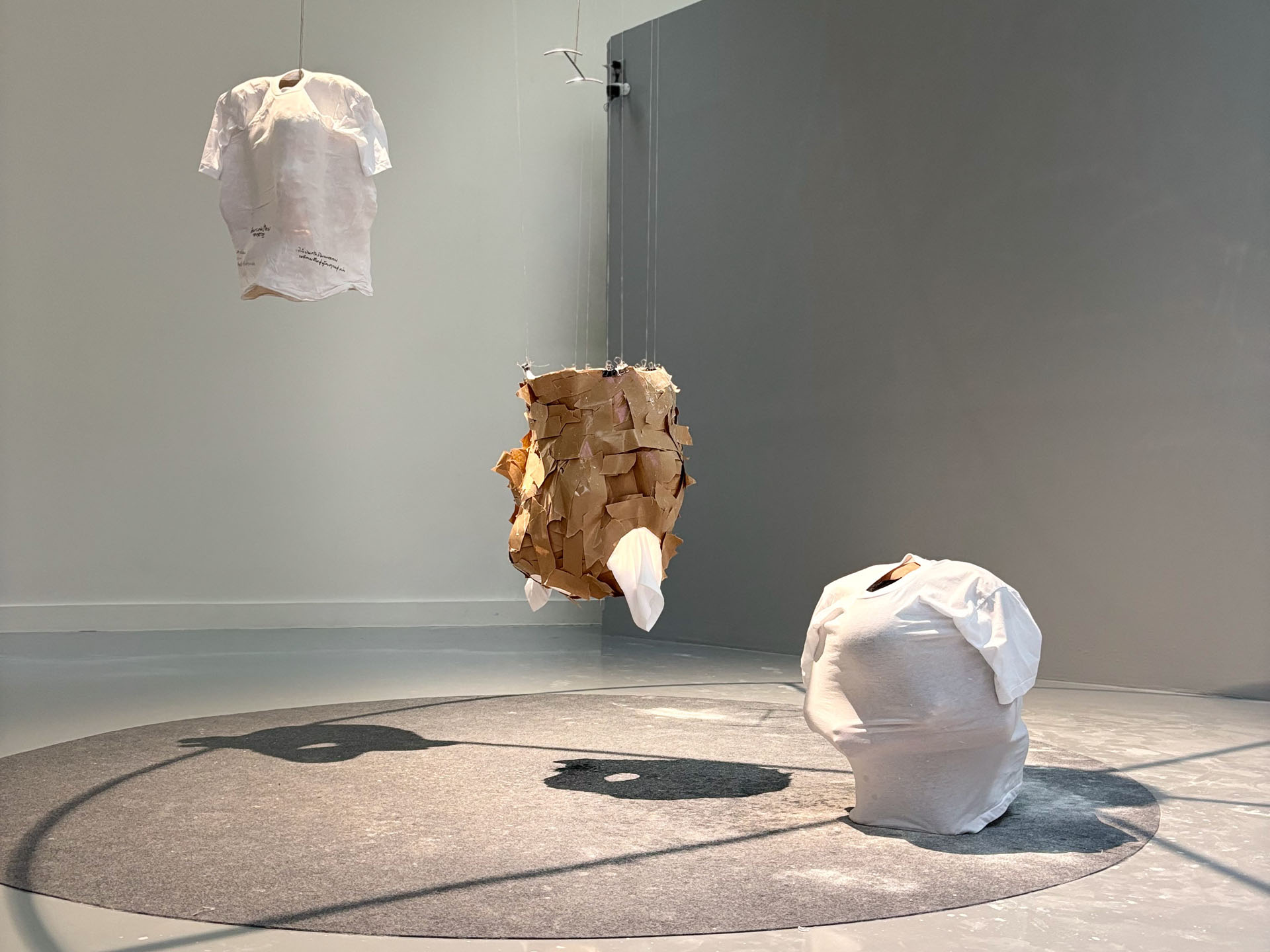
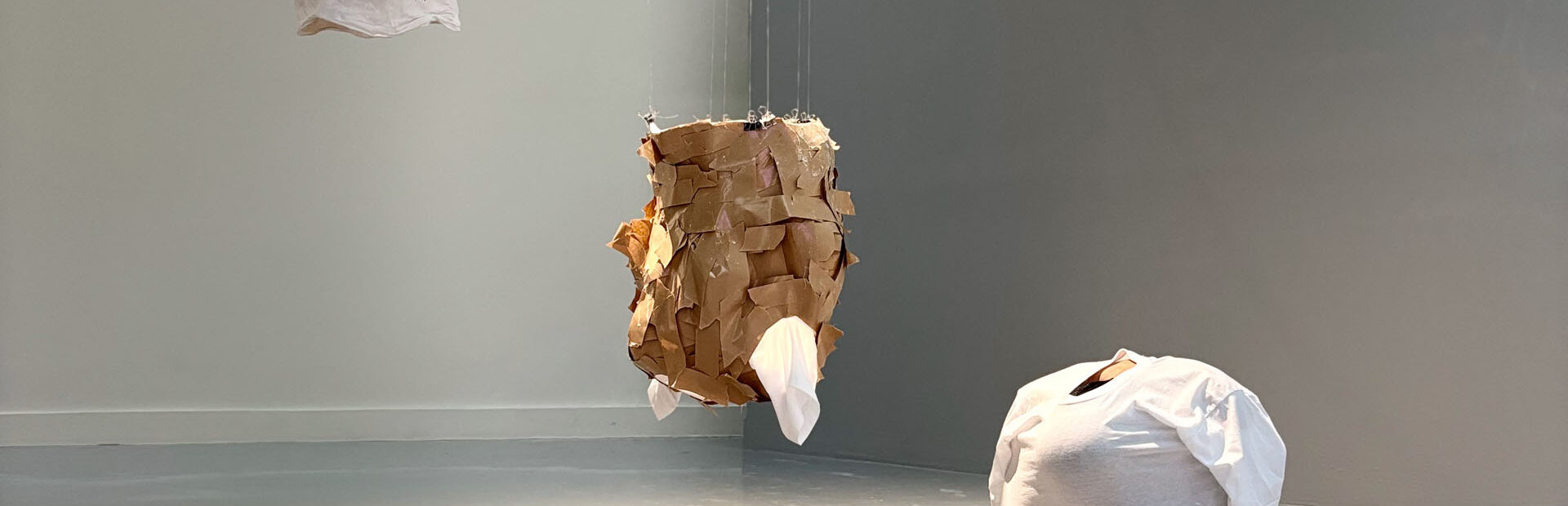
AWDB spoke to Myanmar-born artist Moe Satt following his participation in the Bangkok Art Biennale 2024. During a three-day durational performance, he stayed inside a t-shirt, which was later cast and displayed as an installation. Throughout this process, the audience was invited to write their hopes and wishes for Myanmar on the shirt.
Satt is a visual and performance artist known for his use of symbols and gestures, particularly with his hands, as nonverbal communication. He belongs to a generation of artists who emerged in Myanmar after 2000 who have adopted a subtle approach to commenting on the country’s sociopolitical situation.
This year has been a particularly eventful milestone for the artist. He completed a two-year artist residency at the Rijksakademie in Amsterdam, held a solo exhibition at the Delfina Foundation in London– the first solo by a Myanmar artist in Europe – and he presented a performance at Tate Modern in London.
Can you tell us about your performance and installation, ‘Body Inside T-shirt’, shown at the Bangkok Art Biennale 2024?
‘Body Inside T-shirt’ is from my first performance artwork in 2005. At that time, I stayed inside a t-shirt, moved slowly, and then jumped out of it. Earlier this year, I revisited this work through the lens of the current political situation. So, the work turns performance work into installation work. When you see the ‘Body Inside T-shirt’ work, you know something is inside but you don’t know exactly what it is. It is the same as an outsider who knows something happened in Myanmar, but doesn’t know what exactly is happening.
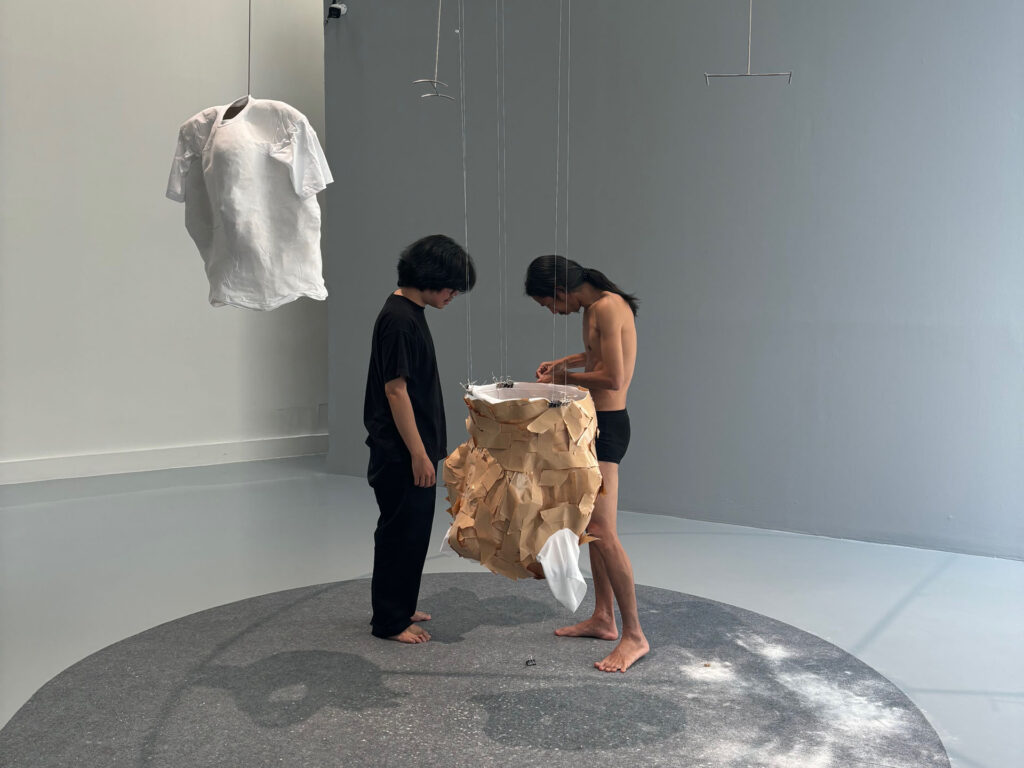
The Bangkok Art Biennale version combines performance and installation work plus the process of sculpture-making in which I invite the audience to write/draw their concerns, hopes, and beliefs about Myanmar’s spring revolution and its citizens. The material I used for making the sculpture was a plaster bandage, which is used to fix broken things and refers to Myanmar society’s need to be fixed. The three days of five hours of durational performance work resulted in three T-shirt sculptures to be shown for the entire Biennial period. The number three refers to the three fingers of our Spring Revolution sign. Also, our Spring Revolution has been over three years, and we are still fighting with the military junta.
You have revisited past performances on a few occasions. Do you feel some works need another iteration to feel complete? How does recreating those pieces in a different context and time work for you?
Ok, I will explain the time frame of my artistic career. I started to do art in 2005 under the rule of General Than Shwe in the military government. When the country’s transition started, I decided to do a ten-year project (2010-2020), digging/looking back to the history as much as I could and my own interpretations. The project looked at what happened in Myanmar in the 80s, 90s, and so on, especially dealing with the country’s politics. After that project, I was planning to do something else. I mean, no more direct politics or anything like that.
But, what happened in 2020? Everybody knows that the pandemic happened, and everything was paused/frozen. Honestly, my ideas dried up at that time. So, I looked at my early practice and realised that some of the works that I had only shown once in Myanmar needed some upgrades with new interpretations. So far, I’ve made two revisited works. ‘hunting and dancing’ (2006) turned into ‘Nothing But Fingers’ (2023), and ‘untitled-1’ (2005) turned into ‘Body Inside T-shirt’ (2024).
To answer your question, I didn’t mean to make a complete one. The works, old or new, have their own unique versions/values. Those works can have different energy and value. What I did was a little bit of extending and upgrading, and switching of the medium. I am happy with both the old and the new works.
My age, at the time, of creating those works was different. Early works were made by the young me with little knowledge, a revolutionary mind with strong energy, and new (revisited ) works were made with experience and some knowledge. In the mid-career stage, the young/strong energy is gone, and one uses experience and knowledge to drive it.
You have just completed a two-year residency program at the Rijksakademie in Amsterdam. It is a unique program due to its duration and the large number of artists it hosts. How was the experience? How does it compare to other shorter programs you attended?
I’ve been in many artists residency programs – more than ten times. Most of them were short residencies: one, two, or three months, and the longest one was six months at the ACC in New York. Some provided a studio space for producing the artworks, and some were research-based. For example, during those shorter residencies, I did some research and produced some photo and video-based work, and after I got back home, I made an art exhibition. I’ve been alone in all of them, not with my family. But now I was able to bring my whole family to the Rijksakademie – my wife and two kids.
The Rijksakademie is a very special program as they provide a family apartment and studio for art practices. There are also many workshops in that compound. Wood workshop, metal workshop, media lab, print lab, paint workshop, mould workshop, ceramic workshop, photo and video studio, sound studio, and so on. All the things an artist needs. Artists have an idea, and that idea can be realised and made to happen. Most technicians are very friendly and willing to help the artists. Advisors are also very nice and give suggestions for developing those ideas. As Myanmar artists, we don’t have that kind of facility in our country, so we seize these opportunities to make new works.
Two years was quite long, but with the family, I tried to balance family time and artist life in a foreign land. Once a year, Rijksakademie has an open studio for the public. My favourite part was the open studio for the public and the internal open studio as well. In the internal one, you can see other artists’ practice and work-in-progress pieces.
After the two open studios, the result was two solo exhibitions. The work I created for the first year became a solo exhibition, ‘Hunting & Dancing: 15 years’ shown at Nova Contemporary, Bangkok, Thailand’. The work I created in the first and second year in the studio became a solo exhibition, ‘Rest the Thumbs on the Cheekbones’ presented at the Delfina Foundation, London. During the two years of Rijksakademie, some of my colleagues and I founded a collective called Performance Club involving performance art. The Performance Club members met in the first year of Rijksakademie and the first event was held in July 2024 at De Thomas in Amsterdam. Even though we have all finished the Rijksakademie, we plan to perform together in the future. Stay tuned for the next Performance Club event in Europe.
On a recent artist talk, you joked that while visiting the Yoko Ono exhibition at the Tate Modern, you felt she could be your mother. Was it a response to a specific work, or do you consider her a big influence? Who are other artists that you admire?
Yoko Ono has been like my mother since I started to do art in 2005, but I have never met her in person. My favourite work is ‘Cut Piece”. I got the idea for using audience participation from that work.
Another artist I admired in my early practice was Bruce Nauman, for his hand sculptures. There is one coincidence: Bruce Nauman created the hand sculpture called ‘All Thumbs’ in 1996. I didn’t know it and I made the hand sculpture, ‘All Thumbs’, in 2007. Eleven years apart, almost the same artwork was created! I got the idea from a book, but I can’t remember the name exactly; the book’s title is the origin of the words or something like that. After I saw his ‘All Thumbs’ sculpture, I did not dare to show my work, but maybe next year, I will show it, and the title will be ‘Artist Hand as All Thumbs’ dedicated to Bruce Nauman.
Your work comments on the social-political situation of Myanmar, a subtle resistance strategy to censorship and oppression. In the Bangkok Art Biennale’s performance, the audience was asked to write their wishes and hopes for Myanmar with a golden pen. What do you think the future holds for your country?
My country has gone back and forth with military rule since 1962, which is why we cannot avoid political issues in our work. I can answer your question with one of my current works, which was shown in my solo exhibitions at the Delfina Foundation a few months ago.
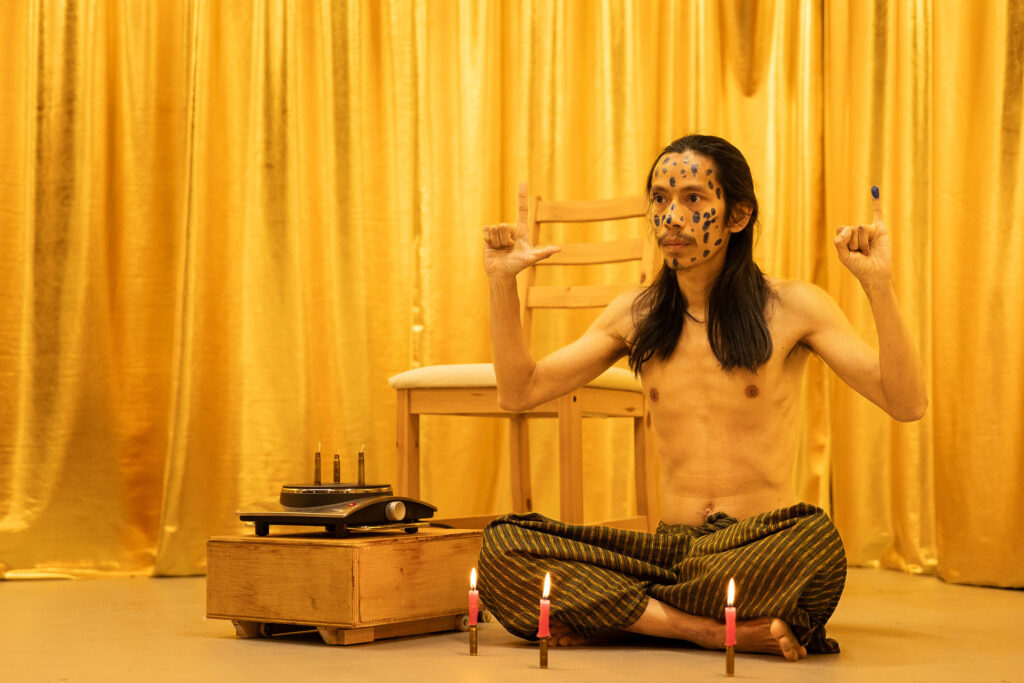
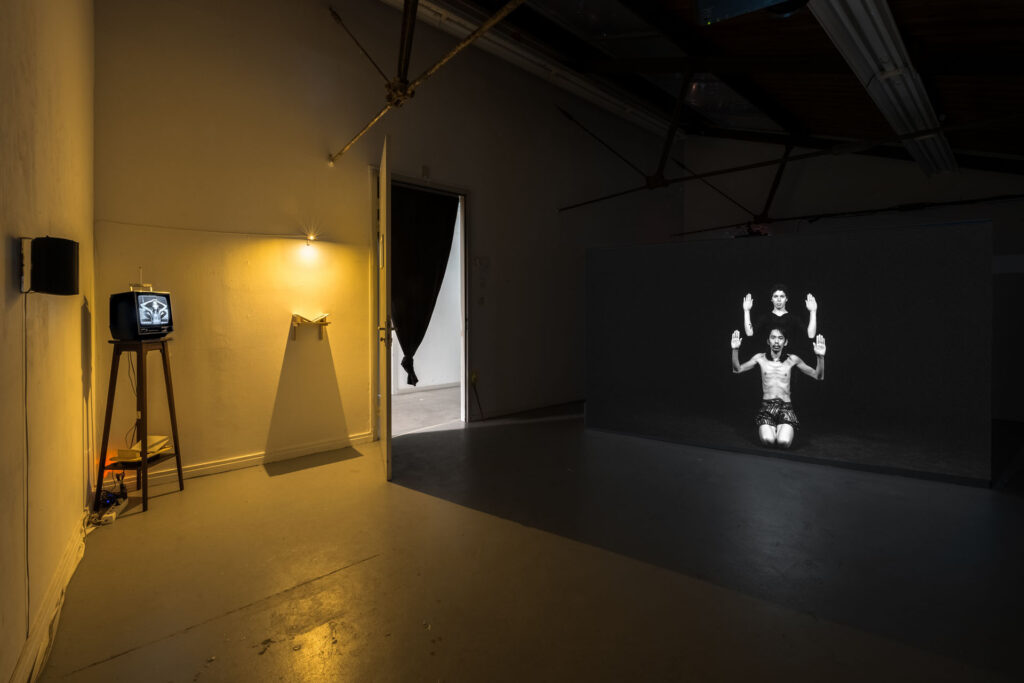
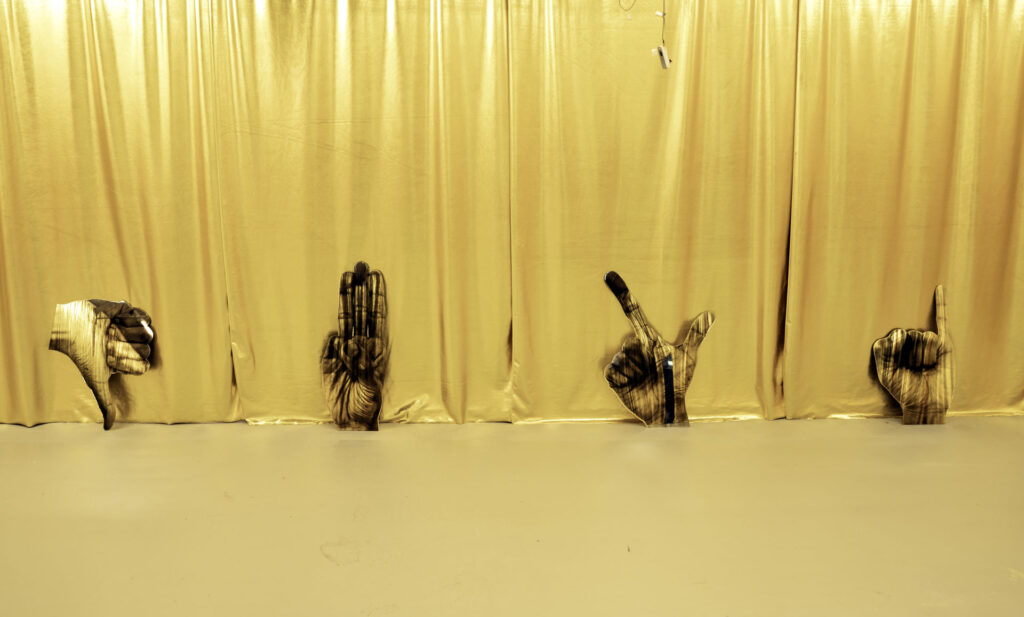
‘Storyline (voted/gun/revolution/thumbs down)’ (2024), for instance, outlines four significant political chapters in the recent history of Myanmar through four hand gestures, all symbols of collective sentiment and actions. They are, from right to left, a pinky up sign meaning ‘I have voted’; a gun sign related to the military coup in Myanmar on 1 February 2021; a three-finger salute, which originated in the Hunger Games film series and later got adopted by activists from Thailand to Myanmar as a symbol of resistance and solidarity for democracy movements across Southeast Asia; and lastly a thumbs-down to express frustration with the current state of the society.
Moe Satt’s video ‘Body Inside T-shirt’ is on view for the Bangkok Art Biennal (BAB) 2024 at Queen Sirikit National Convention Center (QSNCC) until 25 February 2025. For more information, please click here.
INTERVIEW BY GUEST CONTRIBUTOR ALESSANDRA DIAS AND COURTESY OF MOE SATT. DECEMBER 2024.