AWDB speaks to Anthony Chin, a Singaporean visual artist known for his incisive exploration of history, particularly the aftershocks of conflict and colonialism, through material and site. Chin often begins with micro-histories: overlooked or localised events that reveal broader geopolitical forces on a human scale. His practice combines archival research, sculptural precision, and site-responsiveness to confront how systems of power linger in place.
Anthony’s work is currently on display as part of the group show ‘Portals’ in Singapore, until 29 June. His work is shown alongside six other Singaporean artists, all responding to Singapore’s wartime history, specifically exploring the use of technologies and systems to reclaim power and place. Being held at a former British underground command centre, Battlebox in Fort Canning, is especially resonant for Chin, whose installations often engage directly with the histories embedded in the spaces they inhabit.
Could you walk us through the work you’re showing as part of ‘Portals’, and how it responds to the return of the British to Malaya in 1945 and its effect on opium use in Singapore?
The work being shown at the Battlebox is titled ‘B.M.A’. It responds to the British Military Administration (BMA) that was set up for British reoccupied territories in 1945. Within its short operational period of six months, the BMA imported ‘medical opium’ into Malaya, Singapore, and it soon exploded into an illegal drug trade with 50 million grains (approximately 3,200kg) entering the country.
Opium contributed about 40 to 60 percent of the colonial government’s annual revenue and it remained a key pillar of the fiscal system right into the 20th century. There were estimated around 30,000 of habitual opium smokers, mostly Chinese coolies, when the British returned after the war. The coolies had back-breaking laborious jobs with little family support. The addictive and expensive opium smoking became a form of escape from their harsh realities.
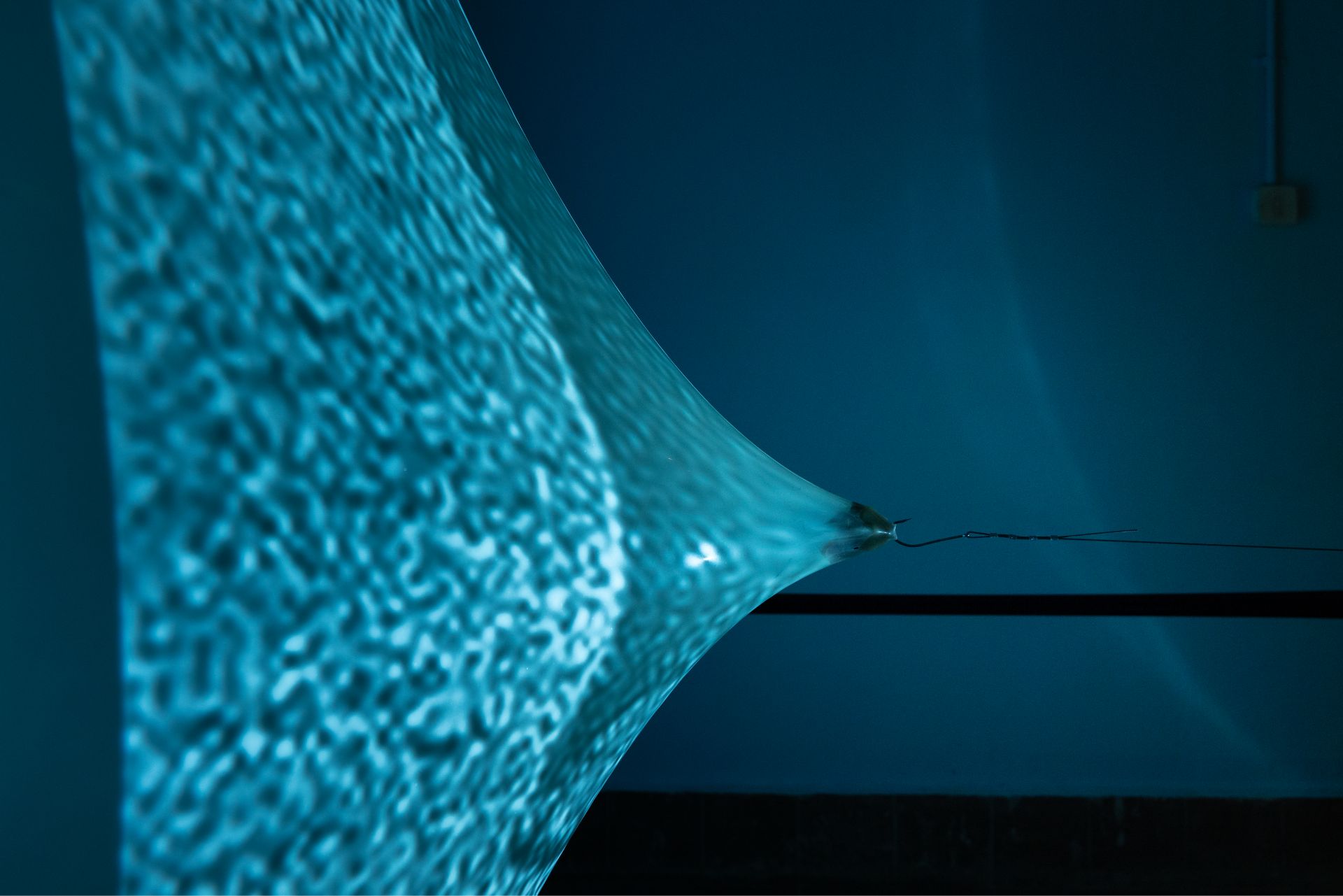
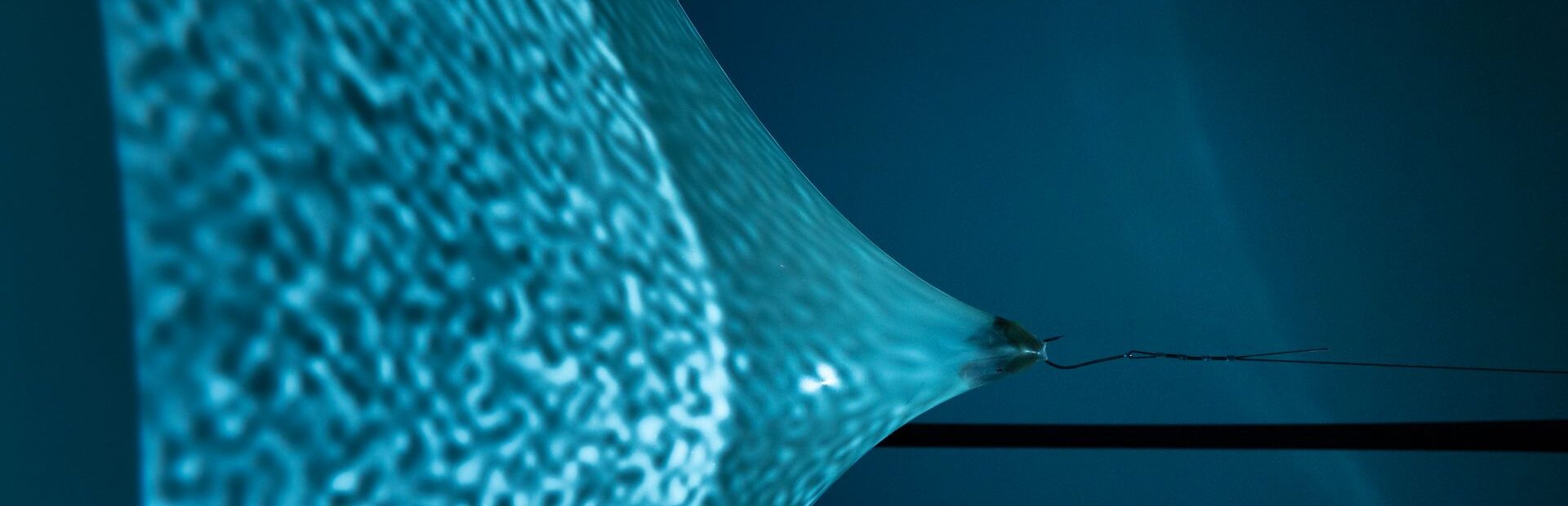
The work has a motorised arm (an image of Louis Mountbatten’s arm is used) that repeatedly tugs a fishing line. A large fishing hook is at the end of the line and it pierces through a projection screen that shows archival images of coolies & opium-related activities or apparatus. The projection screen is deformed when the line is tugged, & hence distorts the projected images. Finally, the motorised arm also reaches towards a Straits Settlement penny (one-cent coin) while it repeatedly pulls on the fishing line.
‘B.M.A.’ is about the extraction and exploitation of the poorest of British Malaya and the Battlebox as a British-built bunker of concealed shame.
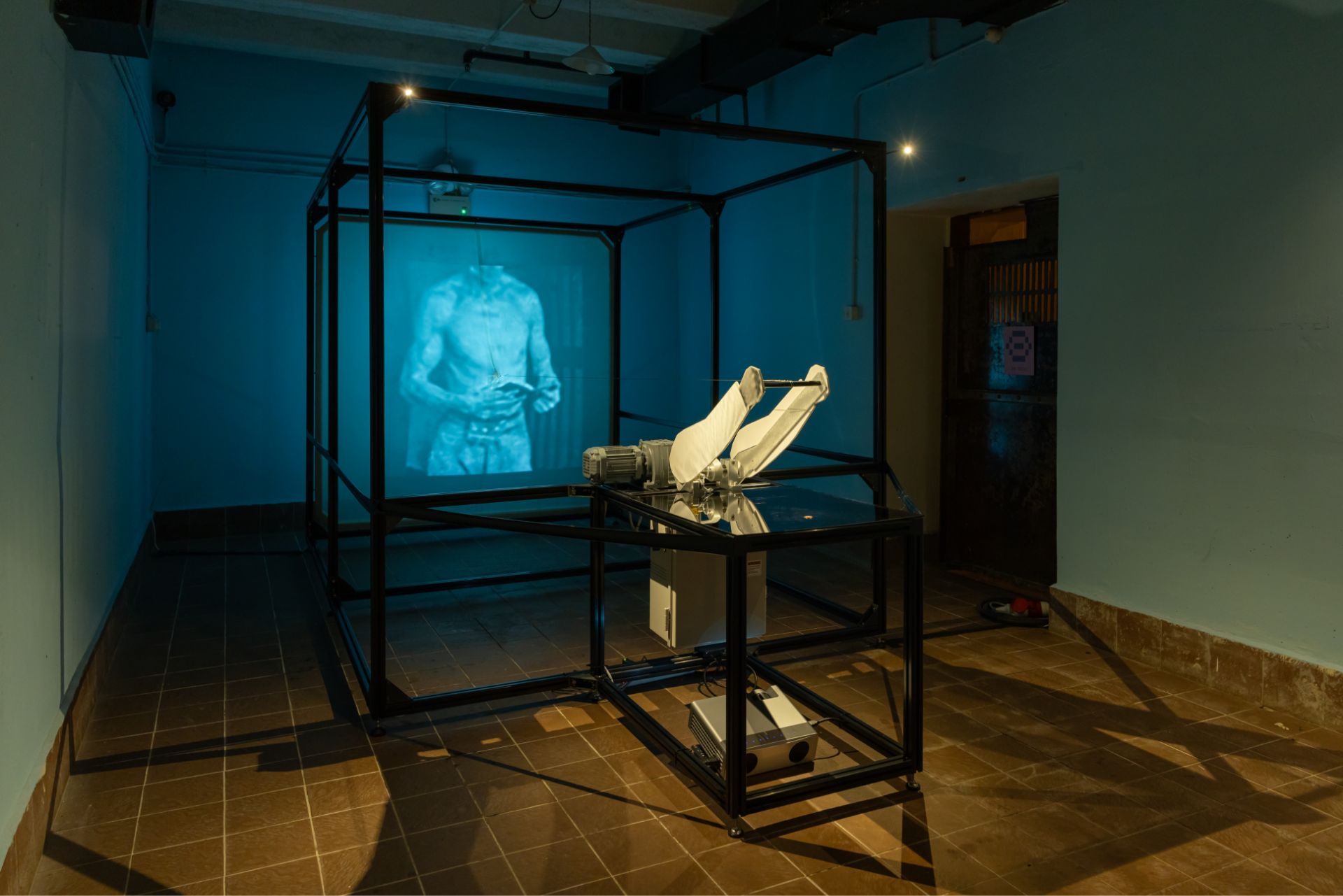
Anthony Chin, ‘B.M.A’, 2025, installation view. Image courtesy of the artist
‘Portals’ is hosted in Battlebox, a former WWII command centre – it feels very fitting for your work, which often is in conversation with a site’s history. How did the setting affect your installation here?
Battlebox provided the relevant context for the work. I use ‘borrowing scenery’ (借景) – a concept used in East Asian garden design, to include what is already at a given site. Using/extracting from the venue where the work is shown is an integral part of my site-responsive practice. The underground command post was the venue where the decision to surrender Singapore to Imperial Japan was made – to me, a venue of shame. The idea of shame became the emotion I carried while working on this. Hence, highlighting the colonial British exploitation of the poorest local population through opium reveals another hidden injustice.
War and conflict history is something you explore frequently, like in your ‘Rinnan Steel Mill’ series or ‘OKA9420 岡九四二零’. What brings you back to it, and how do you see them as relevant today?
There is always a war or conflict between states/nations somewhere on earth at any given moment. War & conflict are the ultimate displays of failed diplomacy, and the reasons why such disasters happen are, in principle, very similar throughout history. Much like Mark Twain’s maxim: “History never repeats itself, but it always rhymes.”
Geographical politics dictate how we need to respond to our geography. Being on this tiny island city-state, the sense of vulnerability is felt most intensely. It is also the reason why every male citizen has to dedicate a substantial amount of their life to National Service once they turn 18 years old.
I feel the best way to look forward is actually by looking back. History reveals our achievements and mistakes as a human race. It allows us to understand how and why we got to where we are today. This, in turn, allows us to make informed decisions. Hence, what I do is to use history to help me see what could happen in the future or answer questions about our contemporary existence.
In a world that is rapidly breaking away from the grand concept of Globalisation, I cannot help but actually feel a sense of urgency to what I do.
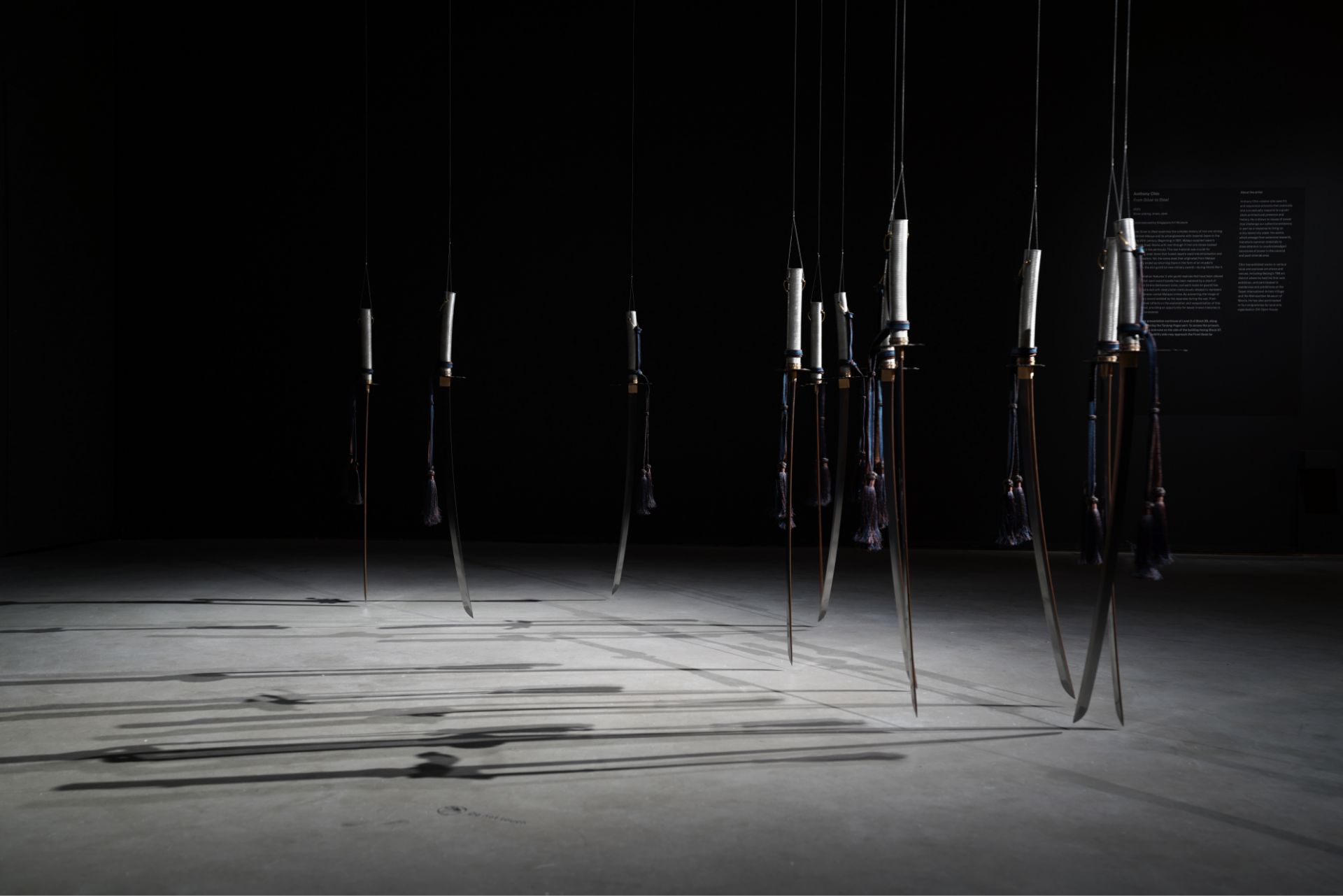
Anthony Chin, ‘From Silver to Steel’, 2023, installation view, Japanese shin guntō steel blade, silver-plating, brass, steel, tassel, 300 x 150 x 150 cm. Image courtesy of the artist
Technology plays a central part in your practice and recontextualises your exploration of your sources. How do you hope the inclusion of tech disrupts or reinterprets your art?
Technology is actually not at the core of my practice. It is present because of the subject matter that I am exploring. Most times, technology becomes a part of my work because of materiality, such as processes of extracting raw resources, conversion of that into usable material, and eventually, manufacturing or construction of the final object or structure. In my research-based practice, such technological advancements and their implications inform my work very directly and become part of my work.
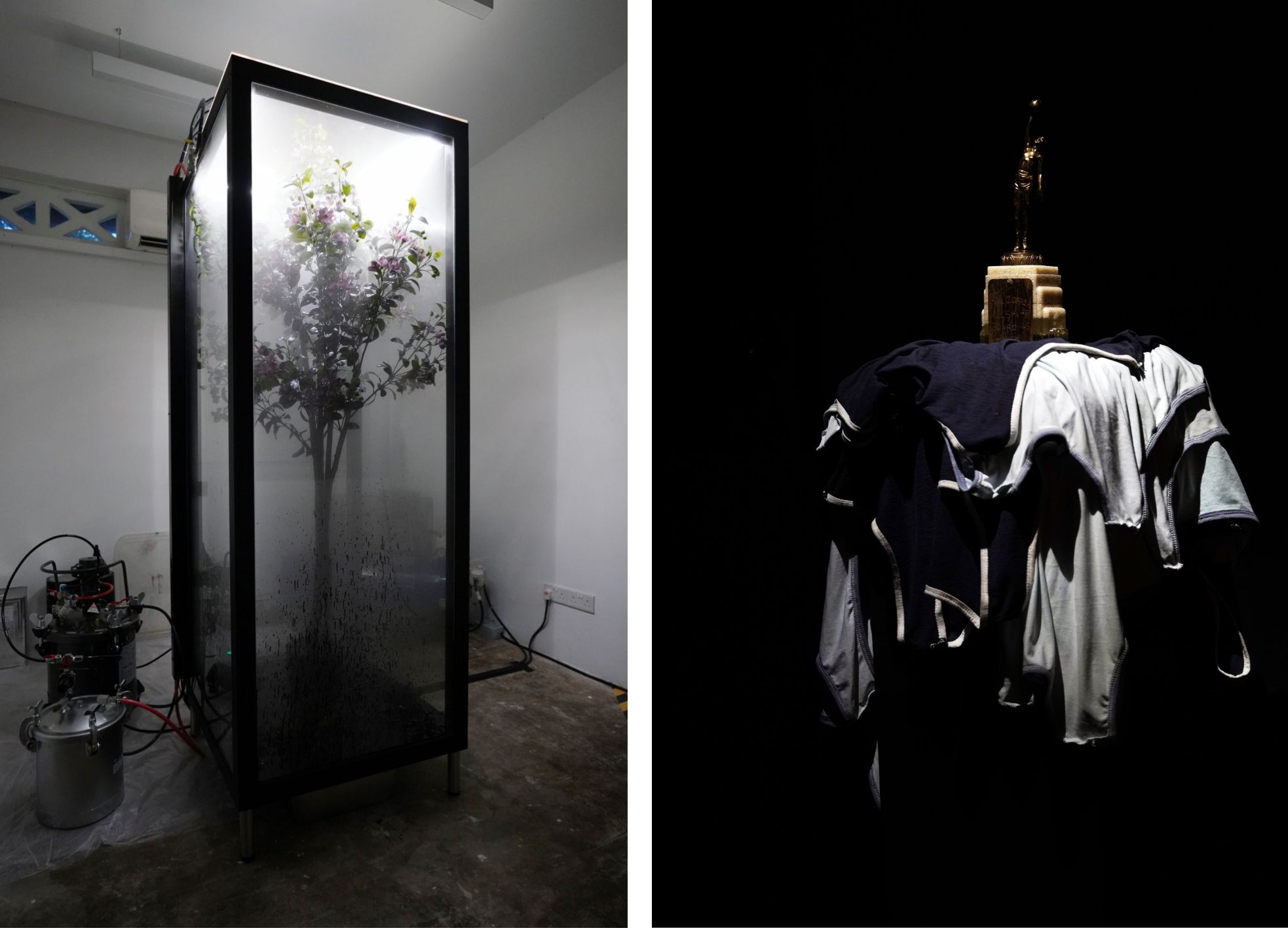
Photo Left: Anthony Chin, ‘OKA9420 – Peach Blossom’, 2025, synthetic peach blossom plant, automated spray paint system, black solvent paint, glass vitrine, 70 x 70 x 210 cm. Image courtesy of the artist Photo Right: Anthony Chin, ‘TROPHY – object’, 2020, vintage American basketball trophy; sweat-salt; epoxy resin; 10 shirts, dimensions variable. Image courtesy of the artist
You’ve spoken previously on your exploration of both micro-histories and larger-scale historical events in your work. When approaching a new project, what influences your research process, and what does it entail?
My process usually starts with research because I am curious about and need to understand a particular subject matter. It could begin with a book, an academic paper, news articles, archival material, etc. I am not a researcher. So when I research, I am looking for something that speaks to me. It then offers a window/way for me to enter into the subject and create a work that responds to what I have found.
The process is always very disorganised and random. I do deliberately allow accidents to happen, simply because this could encourage off-tangent discoveries that I never knew.
I will be part of a group show in Thailand next year, so I have been spending time researching Thailand’s history, especially in relation to a book titled ‘Siam Mapped’, by Thongchai Winichakul. In the book, he illustrates how cartography and maps are an essential part in constructing a nation, national identity, and even nationalism. I am drawn to the period between 1930-1945 because it has direct implications for Malaya during the war.
Anthony’s work is featured in ‘Portals’, on display at Battlebox, Singapore, until 29 June 2025. For more information, please click here.
INTERVIEW COURTESY OF ART WORLD DATABASE AND ANTHONY CHIN, JUNE 2025.