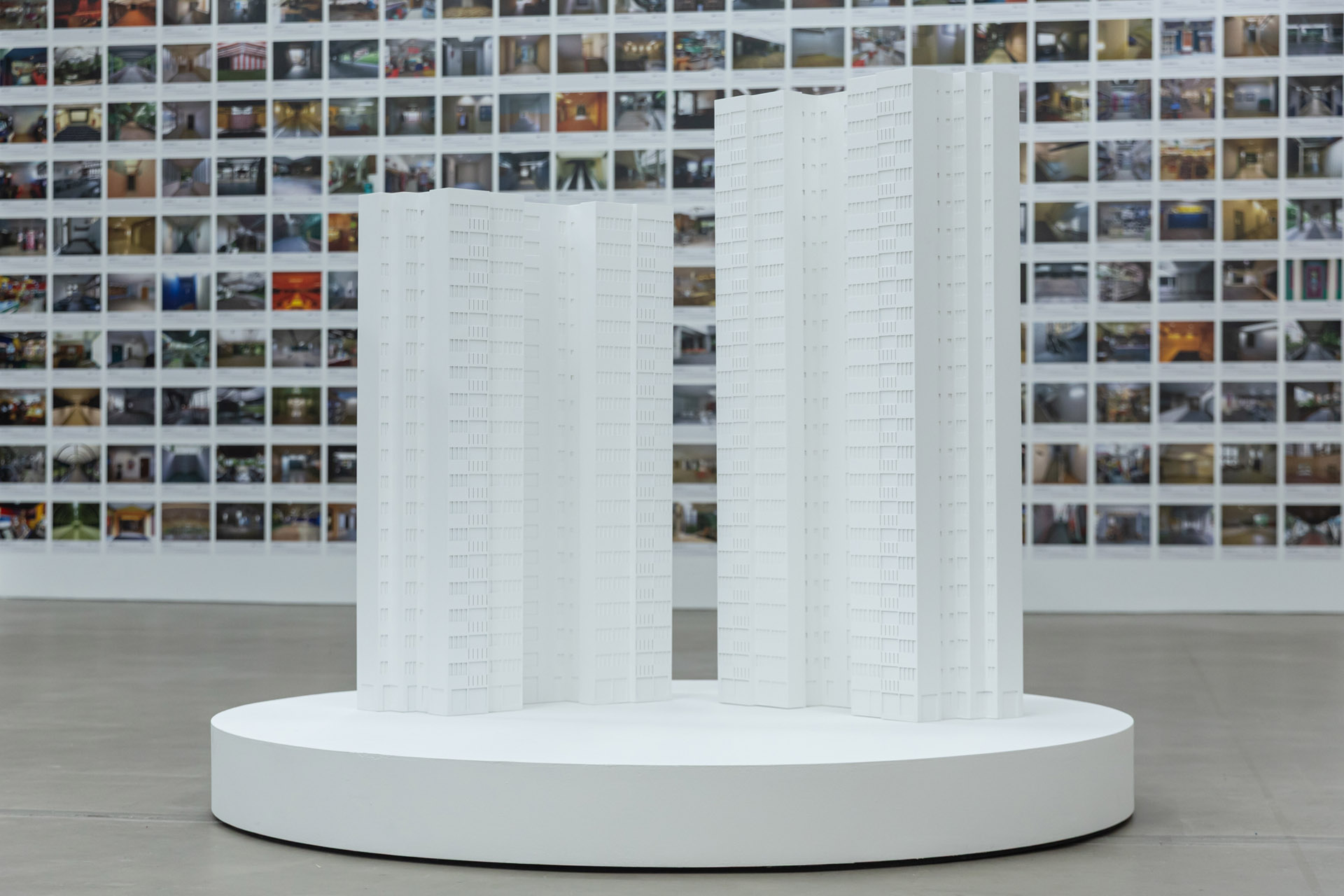
AWDB speaks to Dr. Kathleen Ditzig, Curator at National Gallery Singapore, and Dr. June Yap, Director of Curatorial & Research at SAM, two leaders in their field who recently collaborated on Heman Chong’s ongoing retrospective, ‘Heman Chong: This is a dynamic list and may never be able to satisfy particular standards for completeness’ at Singapore Art Museum.
The show’s title is lifted from Wikipedia’s disclaimer on “incomplete” lists, which, as Ditzig and Yap comment, is a “purposefully lengthy title for the exhibition that reveals the nature of systems within which Heman’s artistic practice operates”. Heman’s work is expansive, ranging across many mediums as represented in this exhibition, and primarily investigates how our everyday infrastructures create associations and serve as understated forms of political expression.

There are over fifty works presented from throughout Heman’s career, which spans writing, performance, publishing, and installation, often blending them. How did you approach curating across such a plethora of mediums?
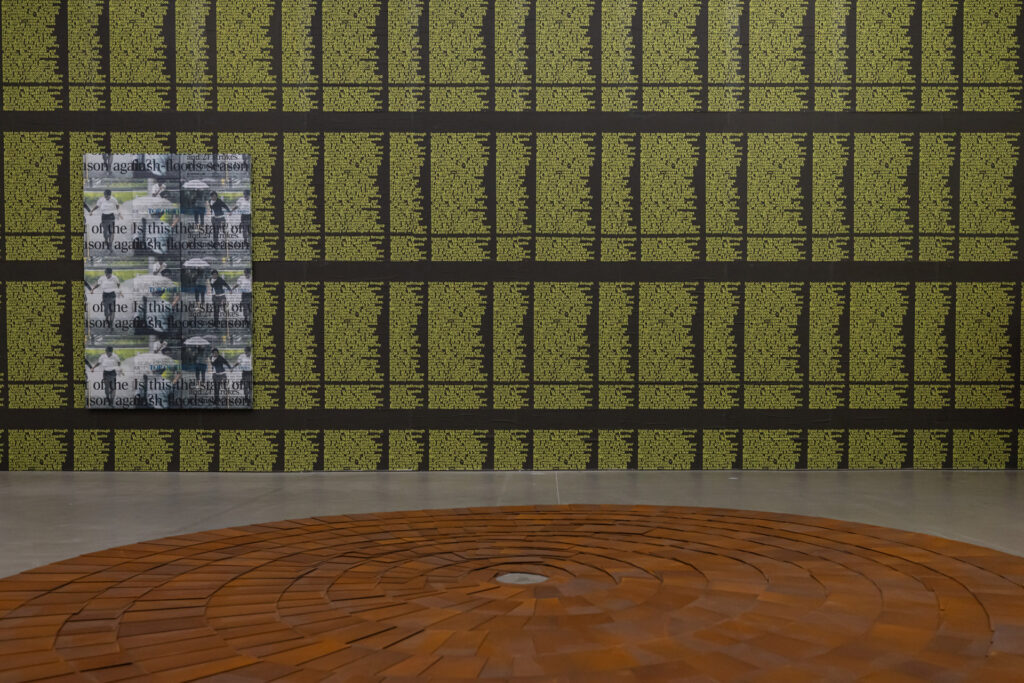
Heman’s practice is simultaneously diverse in medium and prolific in its iterations. We started with a series of long lists of iconic works that Heman has been associated with or that are important art historically, and discussed the shortlist with Heman. Our intention was for the exhibition to reproduce the dialogical nature of his practice, where works may be read as echoes of each other. At the same time, the exhibition is organised into nine rooms, or parts, within which genres and trajectories of Heman’s practice connect, circulate, and detour. Given equally evocative as provocative titles – ‘Words’, ’Whispers’, ‘Ghosts’, ‘Journeys’, ‘Futures’, ‘Findings’, ‘Infrastructures’, ‘Surfaces’, and ‘Endings’ – these spaces perform as if a narrative that allows the viewer to physically enter and explore Heman’s own way of thinking about and through his works.
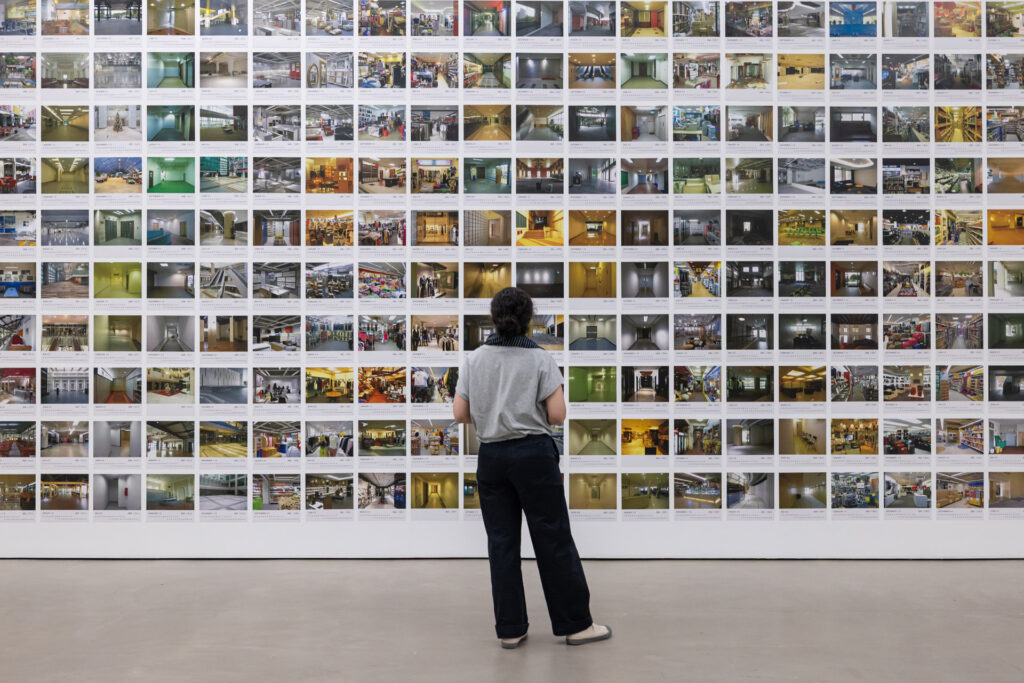
In the room ‘Journeys’, the friendly shopfront shelves of ‘Perimeter Walk’ (2013-2024), where visitors exercise their preferences for the 550-postcard views of Singapore, is juxtaposed with ‘Writing While Walking And Other Stories’ (2020), a breathlessly dense soliloquy by Heman typed into his iPhone during an eight-hour walk. In another example, the mandala-like ‘Paperwork’ (2024), produced using the A4 format that is the backbone of bureaucracy and its almost-religious standardisation, shown within the first room of the exhibition is bookended by the ‘Monument to the People We’ve Conveniently Forgotten (I Hate You)’ (2008) which closes the exhibition with an underfoot experience of blacked-out namecards, with their recognisable palm-size design and implied human connection casually tossed aside.
Heman’s work is globally resonant, but how did Singapore, or Southeast Asia’s regional and geopolitical context, shape your curatorial approach?
While celebrated and circulated globally, Heman’s works are nevertheless imbued with a distinctive Singaporean sensibility that stems from his experience and history living in the city-state. Yet his practice successfully sidesteps overt nationalism and in fact carefully peels back Singapore’s polished veneer, his familiarity performing as a critical lens to examine place, publics and their systems.
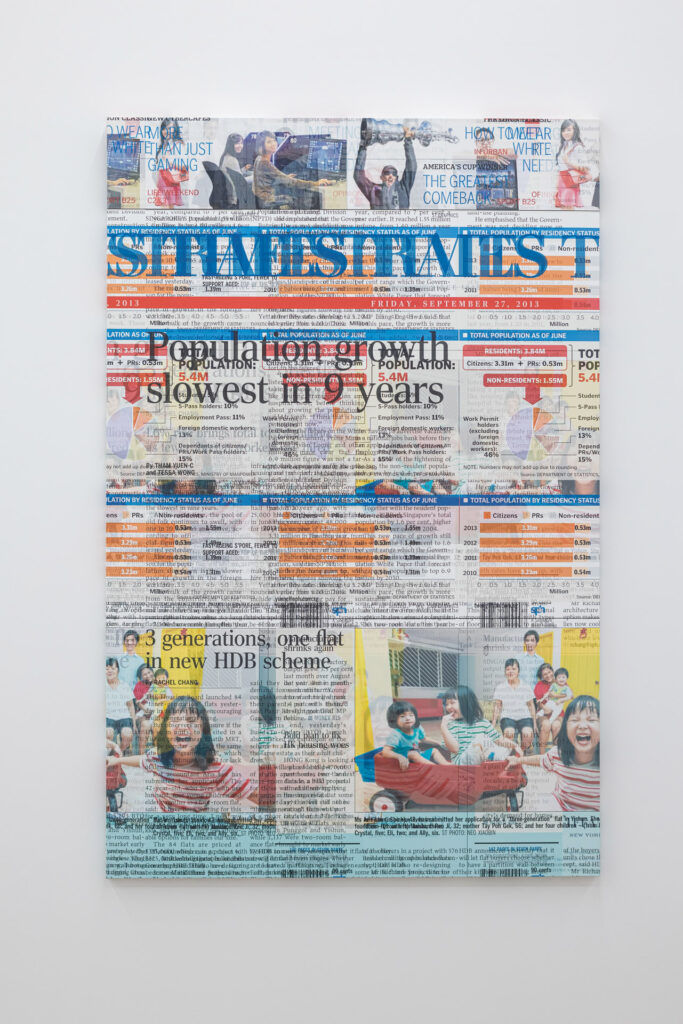
These systems that structure life, relations of power, their dynamics and conditions as portrayed set within Singapore are in fact also relevant to and resonate in the region and beyond globally. Artworks such as ‘Call for the Dead’ (2020) and ‘Foreign Affairs’ (2018) are great examples. While not explicitly of the region, they delve into themes of security and information control, the opaque exercise of state power, and the intricate dance of international relations, which are all deeply relatable.
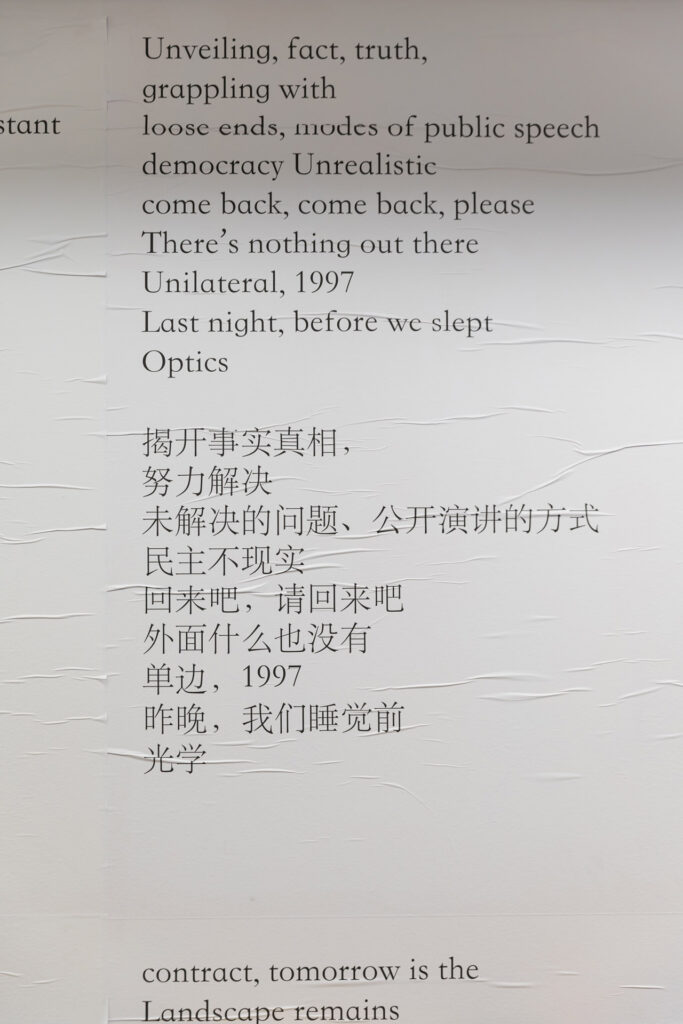
Both performances, ‘A Short Story About Geometry’ and ‘Everything (Wikipedia)’, are durational, open-ended, and the former is dependent on audience participation. How have visitors responded so far when participating?
There is much to unpack from these two performances in the precise employment of the body and its relations. In ‘A Short Story About Geometry’ (2009), the commitment of the participant is arguably more crucial than the story itself as the average time needed to memorise 500 words is approximately three hours, but there have been instances of accomplishing this in as short as 20 minutes, as well as exceeding five hours.
What is less visible in these two works is how Heman selects the performers, which in turn of course affects the audience experience. Over time, there have been refinements of method, and in this presentation at the museum, the performers have either theatre or dance backgrounds, even while the instructions of the performances are intentionally not dramatic. The performers thus appear deliberately everyday and ordinary which then intensifies their textual operations and experience – on the one hand, awash in an endless stream of words from an archive of shared information, on the other, invited into the private world of a story, its words to be saved deep within oneself.
Heman seems to bring into question the value of art in the digital age. Do you see his critique as hopeful or cynical?
The simple binary of hopeful or cynical does not quite apply to Heman’s critique of art and its systems. Instead, it is the interrogation and navigation of systems and their complexities that are of interest to him, and where he prompts viewers to do the same. That said, when it comes to painting, Heman arguably contributes to art historical appreciation. His work ‘Oleanders’ (2023-ongoing) comprises digital images of paintings featuring books as subject or detail, all photographed while he was wandering the Metropolitan Museum of Art in New York over three days in March 2023. Focused on the painted books, the rest of the painting is cropped out of the image, perfect for a game of art history scholarship. Titled after Vincent van Gogh’s still-life within which Émile Zola’s novel ‘La Joie de Vivre’ appears, this archive of historical painting references might be said to be an homage. Yet these digital images, presented on screen in the current exhibition, have also been reproduced as postcards, mimicking those found in museum shops where reproductions are sold to the everyday person who can only afford this retail version. A critique or a democratisation of value? That is for the audience to judge.
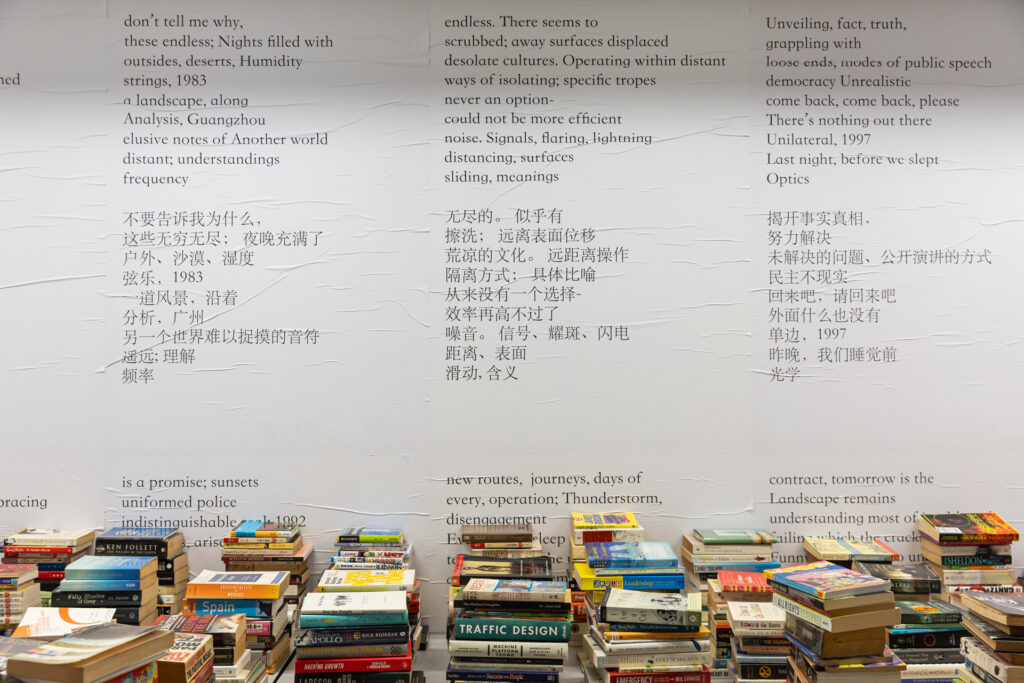
‘The Library of Unread Books’, an ongoing project of Heman’s, which encourages audiences to donate their unread books, has toured here in London recently. What sort of books have been donated during the installation at SAM?
‘The Library of Unread Books’ at SAM is a work of the museum’s collection that began amassing books from the Singapore-based public when it was first presented at the Singapore Biennale 2022. A publicly-sourced library, its inclusive and open structure facilitates a wide, even eclectic, range of publications collected. Contributions to the first presentation included familiar local titles such as ‘The Coffin is Too Big for the Hole & Other Plays’ by Kuo Pao Kun, ‘The Riot Act’ by Sebastian Sim, ‘The HDB Murders’ by Daren Goh, and global staples such as ‘The Unbearable Lightness of Being’ by Milan Kundera. At the current exhibition, donations have since included Eric Hobsbawm’s ‘How to Change the World’ and Wesley Loh’s ‘100 Singaporeans’. The pleasure of browsing ‘The Library of Unread Books’ are the surprising finds and we continue to be fascinated and sometimes intrigued by the books that the public decides to donate. Regardless, we are deeply appreciative of their generous contribution and willingness to be part of this collective social and sculptural experience.
Heman Chong’s show is on display at the Singapore Art Museum at Tanjong Pagar Distripark until 17 August 2025. For more information, please click here.
INTERVIEW COURTESY OF ART WORLD DATABASE, KATHLEEN DITZIG, AND JUNE YAP, JULY 2025